
Search visibility is one of the most powerful, and most misunderstood, growth levers for Shopify stores. Many brands invest heavily in content, apps or backlink campaigns, yet still struggle to achieve consistent organic growth. More often than not, the issue isn’t effort, but foundations.
A client came to me with a Shopify store that looked strong on the surface: solid products, healthy demand and a steady stream of paid traffic. However, organic performance had plateaued, and previous SEO work had delivered diminishing returns. With rising acquisition costs elsewhere, they needed SEO to scale into a more reliable channel to support their growth.
I was brought in to carry out a focused Shopify SEO optimisation sprint, aimed at fixing structural issues, improving how search engines interpret the site, and building a framework for sustainable organic growth.
The Problem
Shopify isn’t really that SEO-friendly out of the box – compared to more content-focussed platforms, its built-in SEO tools are pretty minimal and offer users little in the way of guidance and themes can be fairly hit-or-miss.
As a result, the client’s store was plagued by common issues:
- Poor on-page hygiene: The quality of meta titles & descriptions varied wildly, images were often missing alt tags, and heading hierarchy was a complete mess.
- Fragmented or incomplete schema: Product and organisation schema were partially implemented, while breadcrumb, offer, and FAQ schema were completely missing.
- Bloated or unstructured theme code: Excessive DOM depth (often an issue on ecommerce sites), duplicated markup and JavaScript-heavy rendering made it hard for search engines to efficiently crawl and understand pages.
- Unfocussed content strategy: Collection and product pages were treated purely as transactional, while blogs had been created to target keywords but were disconnected from commercial intent.
- Weak internal linking: Important pages relied on navigation alone, with little contextual linking to guide users or search engines.
- Performance blind spots: Slow page speed was undermining SEO gains, particularly on mobile.
- Missing/incorrect hreflang tags: One that often trips over multi-language and multi-region stores. Correct hreflang tags are critical for Google to rank the right version of a page in each market and to avoid regional pages being mistaken for duplicates.
In this case, SEO efforts had been layered on top of these issues rather than resolving them. As a result, Google was receiving mixed signals about page relevance, hierarchy, and quality.
The solution
The work was structured around Shopify-specific SEO fundamentals, prioritising clarity, crawlability, and intent.
Schema review and improvement
I audited and rebuilt structured data across the site, consolidating overlapping implementations and ensuring clean, valid markup for:
- Product and offer schema (pricing, availability, variants)
- Breadcrumb schema to reinforce site hierarchy
- FAQ schema where it genuinely added value
This improved eligibility for rich results while reducing the risk of conflicting signals from multiple apps.
Cleaner code and structural improvements
Theme templates were restructured to reduce unnecessary markup and improve semantic clarity. Key content elements were prioritised in the DOM, helping both users and search engines understand pages more efficiently.
Where JavaScript was responsible for rendering critical content, this was minimised or reworked to ensure important information was available without reliance on delayed scripts.
Content strategy aligned to commercial intent
Rather than producing more content, the focus was on producing better content:
- Strengthening collection and product page copy to target high-intent search terms
- Defining clear roles for informational, comparative, and transactional content
- Ensuring supporting content fed authority into key revenue-driving pages
Internal linking and site architecture
Internal links were treated as a strategic asset, not an afterthought. Contextual links were added to reinforce topical relationships, surface priority pages, and distribute authority more effectively across the site.
Performance as an SEO multiplier
Site speed was addressed as a core SEO factor, not a separate technical exercise. Improvements here complemented the structural and content work, reinforcing overall page quality signals (covered in more detail in a dedicated performance case study). You can click here for more about the importance of Shopify site speed.
The results
The combined impact of these changes was a clearer, more coherent site from both a user and search engine perspective. Key outcomes included:
- Improved indexing and richer search result appearances due to clean, consolidated schema
- Stronger rankings for commercially valuable queries tied to collections and products
- Increased organic traffic driven by intent-aligned pages rather than vanity keywords
- A more resilient SEO foundation that reduced reliance on constant content production
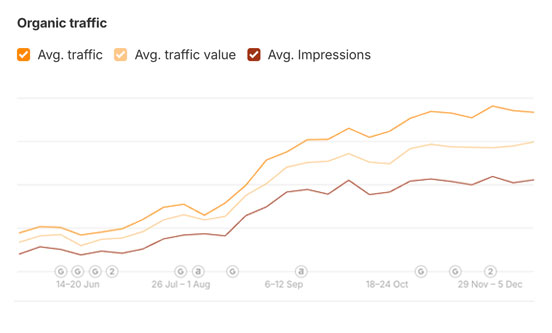
Perhaps most importantly, SEO shifted from being a collection of isolated tactics to a system that supported long-term growth. By addressing Shopify-specific constraints and focusing on fundamentals, the site was positioned to scale organic visibility in a way that was both sustainable and commercially meaningful.
Need help with Shopify SEO?
I can help. Hit the button below to book in a FREE 30-minute review where we can discuss your plans, and I’ll provide no-obligation thoughts & feedback.